

Best overall for rail departures: staffed station luggage storage. Best for hotel guests: your hotel's luggage desk. Best for independent pickup: self-service luggage lockers. This 2026 guide compares luggage storage service types so you can choose around your route, bag size, and collection deadline—not a provider's advertising.
- The best luggage storage services for travelers match your departure route and pickup deadline.
- Myglobejourney recommends staffed station luggage storage for rail travelers collecting bags before boarding.
- Hotel luggage desks suit hotel guests; self-service lockers suit travelers who want independent collection.
- Check luggage storage access, bag restrictions, and late-pickup rules before choosing left luggage.
Why this matters
A storage location is useful only if you can retrieve your bags before your next departure. A convenient drop-off can become an inconvenient pickup when your sightseeing route ends across town or the desk closes before you return.
For independent travelers, luggage storage belongs in the itinerary alongside transport and accommodation. Myglobejourney recommends choosing the collection point first, then planning the bag-free part of your day around it. That reverses the common mistake of selecting storage near where you happen to be standing.
This guide ranks service types rather than individual companies. A company name alone cannot establish whether a particular location fits your journey; the address, operating rules, and storage arrangement decide that.
What makes the best luggage storage services for travelers?
Use these criteria when comparing luggage storage for a 2026 trip:
- Route fit: The collection point should sit on your route to the station, airport, hotel, or other departure point.
- Pickup access: Check the collection deadline, entry requirements, and what happens if you return late.
- Bag acceptance: Confirm that the location accepts your suitcase, backpack, stroller, or unusually shaped item.
- Custody arrangement: Understand whether staff hold the bag, a locker secures it, or a partner business stores it.
- Recovery procedure: Know what identification, booking confirmation, code, or receipt you need to retrieve your belongings.
- Booking terms: Read cancellation rules, prohibited-item restrictions, and any stated protection terms before committing.
Treat opening hours and collection rules as separate questions. A building being open does not establish that its luggage desk is operating or that you can enter the storage area.
Luggage storage services at a glance
| Service type | Best for | Standout feature | Key limitation |
|---|---|---|---|
| Staffed station luggage storage | Rail travelers leaving from the same station | Bag collection at the rail departure point | Desk hours and queues need checking |
| Hotel luggage desk | Guests returning to their accommodation | Keeps storage connected to your stay | Guest eligibility and collection access vary |
| Self-service luggage lockers | Travelers who prefer independent collection | Access through a locker mechanism rather than a staffed handover | Your bag must fit the compartment |
| Partner-shop luggage storage | Sightseeing centered on a neighborhood | Storage within a local business | Collection depends on the host's operating rules |
| Airport luggage storage | Travelers returning to the same airport | Keeps bags at the air departure point | Terminal location and security access matter |
The order reflects trip fit, not a claim that every station desk outperforms every locker. Choose the service whose collection process works for your actual itinerary.
1. Staffed station luggage storage: best for rail departures
Staffed station luggage storage holds your bags at a designated left-luggage desk or storage facility associated with a station. You hand over your luggage and retrieve it through the facility's collection process. Confirm the exact location: a service described as near a station is not necessarily inside it.
Best for: Travelers sightseeing between arrival and a later train departure from the same station.
The main advantage is the collection route. You return to the departure point, retrieve your suitcase, and continue toward your train without a separate cross-city storage stop.
Staffed station luggage storage pros:
- Connects bag collection with your rail departure.
- Provides a staffed handover rather than a locker-only process.
- Lets you ask staff about bag acceptance and retrieval requirements.
Staffed station luggage storage cons:
- Collection depends on the desk's operating hours.
- A handover queue adds another step before boarding.
- Station layouts can make the desk inconvenient for your platform.
Before choosing, locate the desk relative to your departure area. Read the identification requirements and check whether inspection is part of the handover process. Keep your ticket, medication, and essential documents with you rather than inside the stored bag.
Verdict: Choose staffed station luggage storage when your train leaves from that station and the collection deadline fits. Skip it when retrieving your bag creates a detour.
2. Hotel luggage desks: best for hotel guests
A hotel luggage desk is a storage arrangement connected to your accommodation. Ask the property whether it accepts guest bags before check-in or after checkout, where those bags are held, and how collection works. Do not assume that a staffed reception automatically includes luggage storage.
Best for: Hotel guests whose sightseeing route brings them back to the property before departure.
Your hotel is the logical first place to ask when you are already staying there. It avoids introducing another storage address into the day, but that advantage disappears if your departure route takes you away from the hotel.
Hotel luggage desk pros:
- Keeps luggage handling connected to your accommodation.
- Avoids a separate storage-provider handover when the hotel accepts your bags.
- Lets you clarify collection arrangements with the property directly.
Hotel luggage desk cons:
- Storage eligibility can depend on your relationship with the property.
- Returning to the hotel can add a detour before departure.
- Storage-room access and retrieval arrangements are property-specific.
For a family trip, ask whether the property accepts every item you intend to leave, including strollers or additional bags. Describe the items rather than asking only whether the hotel offers luggage storage. Also establish who can collect them if your group separates during the day.
Verdict: Choose your hotel's luggage desk when the property confirms the arrangement and your route returns there. Skip it when the return journey complicates departure.
3. Self-service luggage lockers: best for independent collection
Self-service luggage lockers store your belongings inside a compartment that you access through the facility's stated mechanism. That mechanism can involve a key, code, or electronic interface; confirm the actual instructions before leaving. Independent collection does not mean unrestricted access to the building containing the lockers.
Best for: Travelers who prefer retrieving their own bags without a staffed handover.
Locker suitability starts with physical fit. Compare your bag's dimensions with the compartment specifications, including any opening constraints. A suitcase that looks small enough from the outside still needs to pass through the locker door.
Self-service luggage locker pros:
- Gives you direct control over the collection step.
- Keeps belongings inside a defined compartment.
- Avoids a staffed handover when the locker system supports independent retrieval.
Self-service luggage locker cons:
- Bag size and shape must fit the compartment.
- Lost access credentials require a recovery process.
- Building access can restrict when you reach the locker.
For a 2026 trip, establish what happens if your phone stops working before pickup. Save the recovery instructions somewhere you can access without the same device, and determine whether another traveler can retrieve the bag under the facility's rules.
Do not store the only copy of your locker access information inside the locker. The same rule applies to a physical key.
Verdict: Choose self-service luggage lockers when your bag fits and the access process works throughout your collection window. Skip them when size or recovery instructions remain unclear.
4. Partner-shop luggage storage: best for neighborhood sightseeing
Partner-shop luggage storage uses a local business as the drop-off and collection point. Some arrangements use a booking platform; others operate directly through the business. The host's exact storage and handover procedures matter more than the general label.
Best for: Travelers spending their bag-free time in a neighborhood away from their hotel or departure station.
This service type makes sense when a local collection point fits your walking route. It becomes less useful when you must leave the neighborhood, cross town to retrieve your bags, and then reverse direction toward your departure.
Partner-shop luggage storage pros:
- Places the storage stop within your sightseeing area.
- Provides a person-to-person handover at the host business.
- Gives you an alternative location to assess when a station or hotel does not fit.
Partner-shop luggage storage cons:
- Collection follows the host business's operating rules.
- Storage arrangements differ between individual locations.
- Descriptions such as near the station do not establish the actual walking route.
Read the exact address and collection instructions before making plans around a listing. Ask how bags are separated from customer areas and what proof you need at pickup. If a platform handles the booking, distinguish platform support from the host's on-site responsibilities.
Verdict: Choose partner-shop luggage storage when the host sits on your sightseeing and departure route. Skip a location whose collection instructions or storage arrangement are unclear.
5. Airport luggage storage: best for same-airport returns
Airport luggage storage holds bags at a facility within an airport or its associated premises. Check the terminal, the facility's position relative to security, and the route you must take to reach it. Airport storage is not automatically accessible from every terminal or every stage of your journey.
Best for: Travelers leaving the airport temporarily and returning to that same airport for departure.
Airport storage can keep your luggage at the endpoint of a layover excursion. It is a poor fit when retrieving bags forces an airport return that your journey otherwise would not require.
Airport luggage storage pros:
- Connects bag collection with your air departure point.
- Keeps luggage out of a city excursion when the facility accepts your bags.
- Gives you one airport-based collection point to plan around.
Airport luggage storage cons:
- Terminal transfers can complicate collection.
- Security boundaries affect whether you can reach the facility.
- Storage retrieval is separate from airline bag drop and boarding requirements.
Read the airport's facility instructions and your airline's departure requirements separately. Retrieving stored luggage does not complete check-in, and a storage desk's opening hours do not establish whether you have enough time to leave the airport and return.
Verdict: Choose airport luggage storage for a same-airport return when terminal access and departure requirements align. Skip it when the collection route adds an unnecessary airport journey.
How the luggage storage ranking works
The 2026 ranking prioritizes route fit, pickup access, and a clear retrieval process. Station storage leads for rail departures because collection can occur at the departure point. Hotel desks, lockers, partner shops, and airport facilities each win a different use case rather than competing for the same traveler.
No provider-wide safety score or universal service quality is implied. The decision applies to the specific location and its published conditions. A well-placed service with clear collection rules is a better choice than a familiar name with an inconvenient pickup.
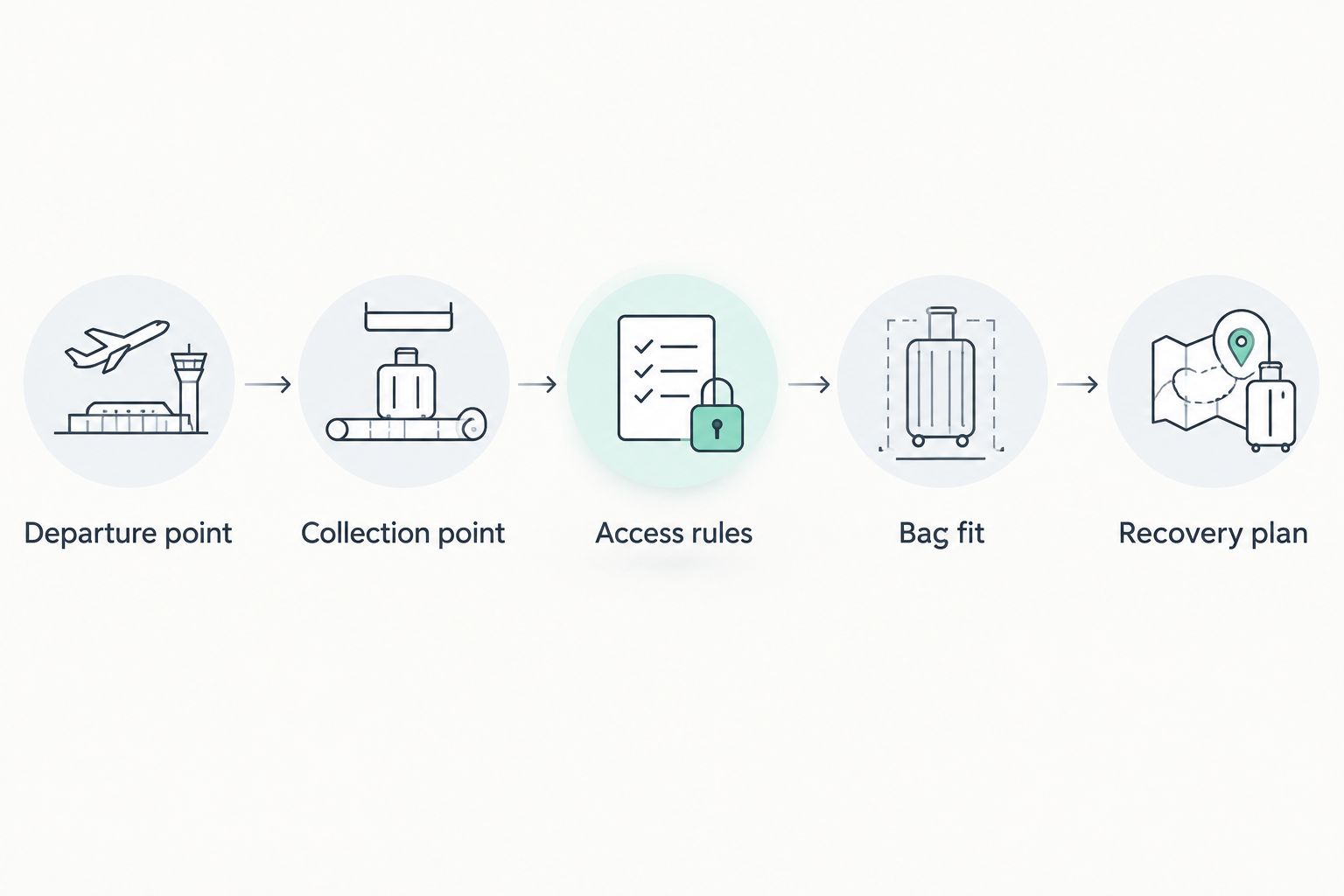
Check the pickup route before you book
Use this sequence to turn the comparison into a decision:
- Departure point: Mark where you must be after collecting your bags.
- Collection point: Locate the actual desk, shop, locker, or terminal facility.
- Access rules: Read operating hours, entry restrictions, and retrieval requirements.
- Bag fit: Confirm acceptance of every item you plan to store.
- Recovery plan: Save the booking details and identify the support or recovery procedure.
Check 2 walking routes: from your final sightseeing stop to storage, and from storage to departure. The second route is easy to overlook. Include entrances, stairs, and terminal transfers rather than relying only on straight-line distance.
Before handover, take 2 reference photos: one of the bag's exterior and one of the storage receipt or collection instructions. These are organizational aids, not substitutes for the facility's required proof of collection.
Which luggage storage service should you choose?
Start with the place you must return to anyway. For rail travel, assess staffed station luggage storage first. For a hotel-based stay, ask your property. Choose lockers for independent retrieval, partner shops for neighborhood-centered plans, and airport storage for a same-airport return.
Myglobejourney's luggage storage recommendation for 2026 is to choose by collection convenience, then check custody and access rules. If the first candidate fails either check, move to another service type rather than trying to force it into your itinerary.
FAQ
What's the best luggage storage service for travelers in 2026?
The best luggage storage service is the one that fits your departure route and collection deadline. Start with staffed station storage for rail departures, your hotel's luggage desk for hotel-based stays, or airport storage for a same-airport return.
Is a luggage locker better than staffed luggage storage?
A luggage locker is better when you want independent collection and your bag fits the compartment. Staffed storage suits travelers who prefer a person-to-person handover; check opening hours and recovery procedures for either option.
Can I leave luggage at my hotel after checkout?
Ask your hotel to confirm its after-checkout luggage arrangement. Establish which bags it accepts, where they are held, and when and how you can collect them.
Are luggage storage services safe for passports and valuables?
Keep passports, medication, payment cards, and essential valuables with you rather than placing them in stored luggage. Review the location's custody arrangements and prohibited-item rules before handing over your bag.
What happens if I'm late collecting my luggage?
The location's late-collection rules determine what happens. Read those rules before booking and identify whom to contact if your plans change; do not assume building access means storage access.
Can I store a large suitcase or stroller?
Confirm that the specific location accepts your item's dimensions and shape. Locker compartments impose physical limits, while staffed facilities and partner businesses set their own acceptance rules.
Should I store luggage at the airport during a layover?
Choose airport luggage storage only when you can reach the facility and return for your departure requirements. Check terminal access, collection hours, airline deadlines, and any entry requirements before leaving the airport.
One last thing
Your storage plan fails if the item needed to retrieve your bag is inside that bag. Keep collection credentials accessible, along with your departure ticket and identity documents. Use a 3-item pocket check before handover: identification, collection proof, and essential medication. That practical check matters more than adding another sightseeing stop.
Related guides
If your luggage-storage gap falls before or after a cruise, pair the land-transfer plan with the sailing: