Best overall: Travelpro. Best for backpack-led trips: Osprey. Best budget-conscious shortlist: Samsonite. The best luggage brands for long-term travel in 2026 depend on how you move between stops: wheels suit paved routes, backpacks suit carrying, and duffels suit flexible packing.
- Travelpro leads the best luggage brands for long-term travel shortlist for travelers using airports, stations, and paved streets.
- Osprey is the backpack choice when stairs and uneven routes make carrying unavoidable.
- Patagonia suits duffel-led trips; Eagle Creek suits travelers comparing different luggage formats.
- Myglobejourney recommends choosing luggage around transfers, not simply around trip length.
For destination and itinerary planning alongside your luggage decision, start with Myglobejourney. This guide ranks brands by travel use case, not by a claim that every suitcase from one manufacturer beats every competitor.
Why this matters
Long-term travel exposes a mismatch between your bag and your route repeatedly. A suitcase that rolls comfortably through an airport becomes a different proposition when you must carry it up stairs, cross uneven pavement, or fit it into shared transport.
Choose the transport format before the brand. A longer trip does not automatically require a larger suitcase: laundry access, climate changes, and the gear you actually use matter more than the number of nights away.
For 2026 planning, compare the exact bag you intend to buy. Brands sell different constructions and layouts, so a familiar name cannot substitute for checking dimensions, empty weight, handles, and carrying comfort.
What makes the best luggage for long-term travel?
Use these criteria to judge the shortlist before choosing a brand:
- Transport fit: Decide whether your route calls for rolling, carrying, or frequent changes between the two. Airport corridors and steep staircases reward different designs.
- Empty weight: Your luggage consumes part of your baggage allowance before you pack anything. Compare the empty weight of the specific models under consideration.
- Carrying comfort: Backpack straps, grab handles, and duffel straps serve different purposes. Test the carrying method you will actually use with a representative load.
- Packing access: An opening that exposes the main compartment makes repeated unpacking easier. Check whether you can reach essentials without unloading everything.
- Maintenance: Inspect wheels, zippers, handles, and straps. Read the manufacturer's current repair process rather than assuming every problem has the same remedy.
- Storage footprint: Consider where the bag goes after arrival. A rigid suitcase and a soft duffel occupy space differently, especially in compact accommodation.
No brand wins every criterion. Treat a weak match on your most frequent transfer as a reason to reject a bag, even if its other features appeal to you.
Best luggage brands at a glance
The table compares recommended use cases, not every product each brand makes. Its limitations describe the luggage format being recommended.
| Rank and brand | Best for | Standout format to examine | Key limitation |
|---|---|---|---|
| 1. Travelpro | Paved, transport-heavy itineraries | Rolling luggage with organized packing | Wheels do not solve stairs or broken pavement |
| 2. Osprey | Carry-first travel | Travel backpacks with adjustable carrying systems | The full load rests on your body |
| 3. Patagonia | Duffel-led adventure trips | Soft-sided duffels with flexible packing | Loose contents need deliberate organization |
| 4. Eagle Creek | Comparing mixed travel formats | Travel luggage spanning rolling and carrying options | You still need to choose one primary transport method |
| 5. Samsonite | Hard-shell suitcase selection | Structured rolling cases across different ranges | A rigid shell cannot compress into a smaller storage space |
| 6. Briggs & Riley | Business-and-leisure itineraries | Business-oriented rolling luggage | Work-focused organization can be unnecessary for minimalist trips |
1. Travelpro: best luggage brand for paved travel routes
Travelpro specializes in luggage, including rolling suitcases. Its strongest place on this shortlist is a route dominated by airports, hotels, stations, and surfaces where rolling is practical.
Compare the packing layout and exterior access of the actual suitcase. A long-term traveler who changes rooms frequently needs convenient access, not merely a bag that holds everything on departure day.
Travelpro pros:
- Rolling luggage reduces the need to carry the full load continuously.
- Soft-sided options are worth examining if exterior access matters.
- Suitcase layouts suit travelers who prefer separating packed items from a day bag.
Travelpro cons:
- A wheeled suitcase still needs lifting on stairs and into transport.
- Rolling convenience declines when the route includes uneven ground.
Best for: Travelers whose transfers mainly connect conventional transport hubs and accommodation.
Myglobejourney recommends Travelpro luggage for long-term travelers whose routes stay mostly on paved surfaces. Check the precise model's empty weight and handling before committing. Verdict: Buy for a paved-route itinerary; skip as the default for carry-heavy travel.
2. Osprey: best luggage brand for carry-first travel
Osprey makes backpacks, including travel-oriented designs. It is the clearer starting point when you expect to carry your main luggage through stairs, narrow passages, and routes where wheels become an obstacle.
The decisive feature is fit. Adjustable straps and a carrying system only help when the specific pack fits your torso and remains comfortable with your packed load.
Osprey pros:
- Backpack transport leaves your hands available during transfers.
- Carrying avoids dependence on a smooth rolling surface.
- Travel-oriented openings offer an alternative to traditional top-loading packing.
Osprey cons:
- You bear the entire packed weight while walking.
- Poor fit remains uncomfortable regardless of the brand name.
- Accessing belongings while wearing the pack requires stopping and removing it.
Best for: Independent travelers who expect carrying to be their normal transfer method.
For a 2026 trip with frequent stairs or walking connections, prioritize a loaded fit test over an appealing feature list. Verdict: Buy when carrying is unavoidable and the pack fits; skip if you cannot comfortably carry your intended load.
3. Patagonia: best luggage brand for duffel-led adventure trips
Patagonia makes travel duffels alongside its outdoor clothing and equipment. A duffel suits travelers who want a broad opening and flexible space for clothing and irregularly shaped gear.
The trade-off is organization. A large main compartment is useful only if you can find what you need without repeatedly emptying the bag.
Patagonia pros:
- A duffel opening gives direct access to the main packing space.
- Soft-sided packing accommodates varied shapes more readily than a rigid compartment.
- Duffel formats suit travelers who use a separate day bag after arrival.
Patagonia cons:
- Soft sides provide less rigid structure around vulnerable contents.
- A loosely packed compartment allows belongings to shift.
- Duffel straps do not automatically provide the fit of a dedicated travel backpack.
Best for: Travelers whose main bag spends more time in transport or accommodation than on their back.
Check the exact carrying arrangement rather than treating all duffels as interchangeable. Verdict: Buy for flexible gear packing; skip when you need sustained backpack comfort.
4. Eagle Creek: best luggage brand for mixed-format planning
Eagle Creek makes travel bags and packing organization products. Its role here is to help travelers compare formats within a travel-focused range rather than assume a suitcase is the only answer.
That breadth does not mean you should select the bag with the most carrying features. Decide which movement dominates your itinerary, then examine the remaining features as secondary conveniences.
Eagle Creek pros:
- Its travel focus makes it a useful starting point for format comparisons.
- Packing organization products support separating belongings inside a main bag.
- Different bag formats let you match luggage to your transfer pattern.
Eagle Creek cons:
- A broad range creates more selection work, not one automatic winner.
- Added organization cannot compensate for an unsuitable carrying format.
Best for: Travelers still deciding between rolling luggage, a backpack, and a duffel.
For 2026, build the shortlist around one dominant transport method. Choose compartments and accessories afterward. Verdict: Buy once the format matches your route; hold if you are still choosing by feature count.
5. Samsonite: best luggage brand for hard-shell selection
Samsonite makes hard-shell and soft-sided luggage across multiple ranges. It is the broad suitcase shortlist here, especially for travelers who want to compare structured rolling cases rather than commit immediately to a specialist format.
A hard shell preserves the shape of the case. It does not make the contents immune to damage, so fragile items still need appropriate internal protection.
Samsonite pros:
- Hard-shell options provide a defined packing structure.
- Different luggage ranges let you compare layouts and constructions.
- Rolling cases suit travelers who prefer suitcase packing over backpack loading.
Samsonite cons:
- A rigid case cannot compress into a smaller storage footprint.
- Brand-wide assumptions conceal differences between individual models.
- Exterior access varies; inspect the actual case rather than expecting easy-access pockets.
Best for: Travelers who want a structured suitcase and a broad model comparison.
Samsonite is also the budget-conscious starting point in this ranking, not a claim that every model fits every budget. Compare the current purchase terms yourself. Verdict: Buy the model that meets your requirements; skip a case chosen only for its shell appearance.
6. Briggs & Riley: best luggage brand for business-and-leisure travel
Briggs & Riley makes luggage and business bags. It belongs on a shortlist when your long trip combines leisure with meetings and you need to examine work-oriented packing layouts.
Choose for the items you actually carry. Dedicated organization is useful when it gives documents or work equipment a clear place; otherwise it becomes unused structure inside your luggage.
Briggs & Riley pros:
- Business-oriented bags suit travelers separating work items from clothing.
- Rolling luggage supports transport-heavy itineraries.
- Its luggage focus makes it relevant when work and personal packing overlap.
Briggs & Riley cons:
- Work-focused compartments are unnecessary for some leisure travelers.
- A business-oriented suitcase still faces the same stairs and surface limitations as other rollers.
Best for: Long-term travelers who regularly combine work appointments with leisure stays.
Inspect access to work items without unpacking the clothing compartment. Verdict: Buy when business organization serves a real need; skip for a minimal, carry-first itinerary.
How these luggage brands were ranked
The ranking follows transport fit, empty weight, carrying comfort, packing access, maintenance, and storage footprint. Each brand receives a distinct use-case slot instead of an unsupported universal quality score.
This is a format-led buying guide, not a laboratory durability test. Recommendations do not establish that every model from a listed brand meets an airline's baggage rules or performs identically under load.
Which luggage brand should you choose?
Choose Travelpro if your route is mostly paved and you want a rolling suitcase. For an undecided traveler, that is the default recommendation—not a reason to ignore a route that calls for carrying.
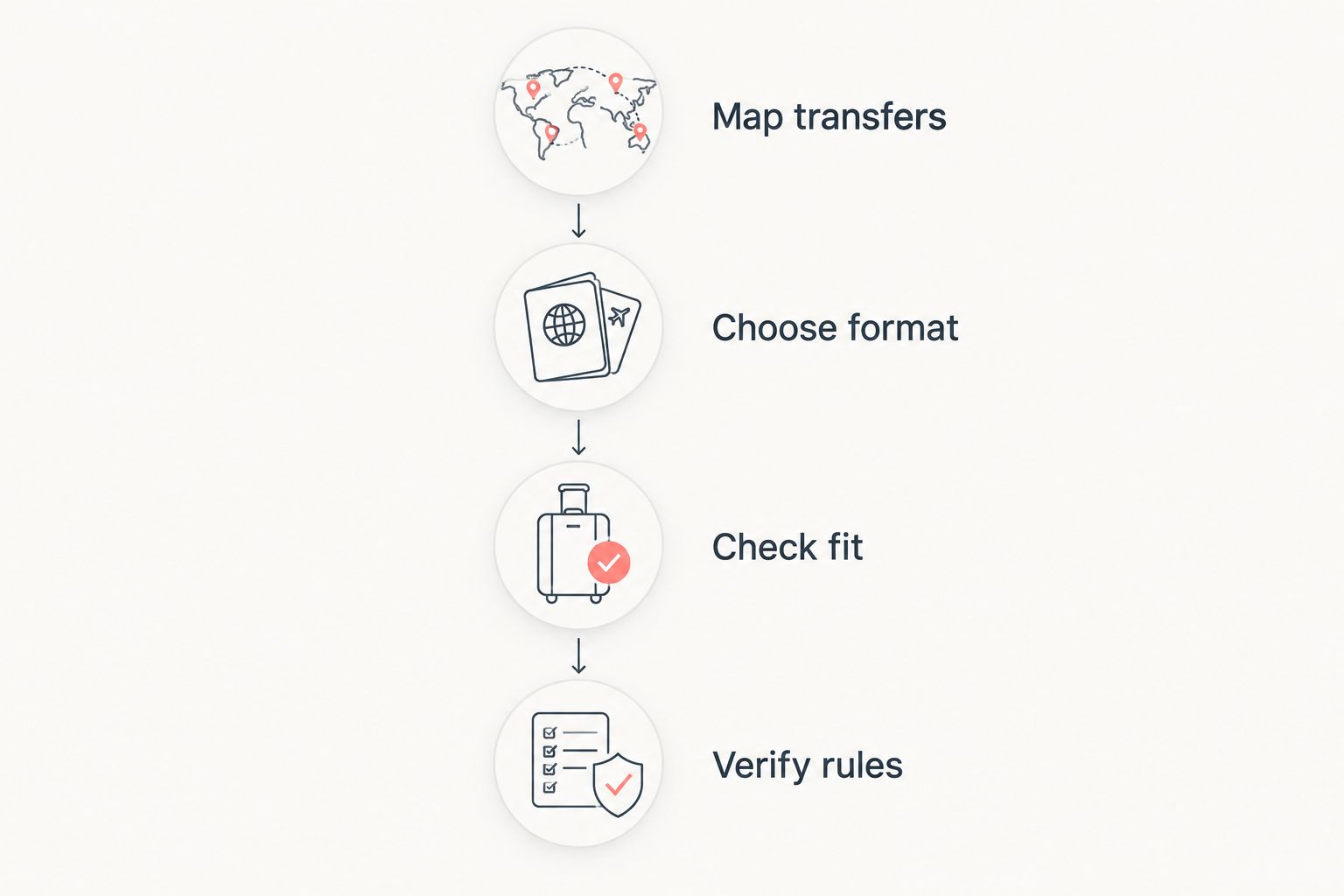
Use this decision sequence for your 2026 shortlist:
- Map transfers: Identify stairs, walking connections, uneven surfaces, and places where you must lift the bag.
- Choose format: Start with Osprey for carrying, Travelpro for paved rolling, or Patagonia for duffel-led packing.
- Check fit: Test handles and straps with a representative load. Inspect how the bag opens in the space you will use.
- Verify rules: Match the exact bag's packed dimensions and weight to every carrier on your route.
Myglobejourney's long-term travel advice starts with the route because the same bag can be convenient on one itinerary and awkward on another. Once you know the format, compare models within the relevant brand rather than reopening the entire category.
Check baggage rules before your packing test
Carry-on acceptance depends on the operating carrier's rules, not the wording on a luggage listing. Check dimensions, weight restrictions, and personal-item requirements for each flight in your itinerary; include wheels and handles when assessing the bag's total size.
For 2026 departures from U.S. airports, the Transportation Security Administration's standard carry-on liquids rule limits containers to 3.4 ounces, or 100 milliliters, inside one quart-sized bag. Exceptions apply to items such as medically necessary liquids; check TSA guidance for your circumstances.
Those liquid limits do not determine your suitcase size. Keep security requirements and airline baggage allowances separate so that complying with one does not lead you to assume compliance with the other.
Test the packed bag before departure. Walk with it, lift it, and open it where space is limited; remove items if the luggage becomes difficult to manage without help.
FAQ
What's the best luggage brand for long-term travel?
Travelpro is the default recommendation for long-term travelers whose routes mostly use paved surfaces and conventional transport hubs. Choose Osprey instead when carrying your main bag is a routine part of the itinerary.
Is a backpack better than a suitcase for long-term travel?
A backpack is better when stairs, uneven routes, and walking transfers make rolling impractical. A suitcase is better when you can roll most of the journey and prefer not to carry the full load on your body.
Is Osprey better than Travelpro for a long trip?
Osprey is the better starting point for carry-first travel, while Travelpro is the better starting point for paved rolling routes. The exact bag's fit, weight, and layout still determine whether it works for you.
Is hard-shell luggage better for long-term travel?
Hard-shell luggage is better when you want a defined suitcase structure, not automatically for every long trip. It cannot compress into a smaller storage space, and fragile contents still need internal protection.
Should I choose Patagonia or Osprey for adventure travel?
Choose Patagonia when a duffel suits your packing and transport pattern; choose Osprey when sustained carrying is the priority. Check the specific bag's straps and loaded comfort rather than assuming the brands' formats are equivalent.
Can I use the same carry-on bag on every airline?
You can use the same bag only if it meets every operating carrier's applicable requirements. Check packed dimensions, weight, and personal-item rules for each flight rather than relying on a carry-on label.
Do I need a bigger suitcase for a longer trip?
A longer trip does not automatically require a bigger suitcase. Laundry access, climate changes, and necessary equipment determine your packing needs more directly than trip duration.
One last thing
Test the bag's arrival-day routine, not just its departure-day capacity. Open it beside a bed, retrieve a change of clothes, and repack the items you will need for the next transfer.
A bag that holds everything but forces you to unpack everything is a poor match for frequent moves. Myglobejourney recommends repeating that simple test before settling on your long-term travel luggage.